Language & History
Why “Jamestowne”? — Spelling and Writing
Off the Map — a question I couldn't let go of
It started with one small thing that nagged at me: why do some places write Jamestowne, with an e, and others write Jamestown? My first guess was the obvious one — somebody, somewhere, must have misspelled it in an old document, and the mistake just stuck.
So at Historic Jamestowne, I asked a ranger. She looked at me a little puzzled, not quite sure what I was really asking. Then another ranger sitting next to her caught on — and realized the thing I didn't know wasn't about Jamestown at all. I didn't know that English spelling used to have no rules.
He explained it gently. Before English spelling was standardized, people simply wrote words the way they said them. Spelling followed the ear, not a rulebook, so the same word could be written several different ways and none of them was wrong. There was no such thing as a misspelling, because there was nothing to misspell against. And it wasn't only Jamestown — in that era, any town could just as easily be written towne.
I'm not sure how to say it in English. In Japanese we'd say me kara uroko — like scales falling from your eyes. It was more than an eye-opener. A whole assumption I'd carried my entire life, that every word has one correct spelling, turned out to be a fairly recent invention.
How the rules arrived
I read more about it afterward. English spelling only settled into something like today's over roughly two centuries. The printing press started it — once printers were setting type, consistent spelling was simply cheaper, and by the late 1500s the wild variety had already shrunk. The King James Bible of 1611 nudged everyone toward the same habits. Then Samuel Johnson's dictionary in 1755 pinned spellings down in one place, and on the American side Noah Webster later tidied them again (that's color, not colour). That's why the neat modern Jamestown won out in print — while the preserved site deliberately keeps Jamestowne, the spelling from the colony's own century, before the rules caught up.
A Better Sense for Guessing
Once I understood that, I couldn't stop wondering how people even communicated back then. Almost everything traveled by letter. If the person writing to you spelled things their way and you spelled things yours, wouldn't that make it harder to understand each other? I imagine there was far more miscommunication than we have now — and no way to fix it in the moment. No phone call to ask "wait, what did you mean?", no search bar to check. I think people just filled the gaps with imagination and trusted that they'd understood each other. Maybe they were better guessers than we are now — more practiced at reading between the lines, because they had no other choice.
The signature that wasn't beautiful
There's a related thing I'd always wondered about too: why were the people in history books all such beautiful writers? Their handwriting looks almost like it came out of design software — every letter even and elegant. Did they hire secretaries to write their letters? But formal education was rare, especially for women, so who exactly was doing all that gorgeous writing?
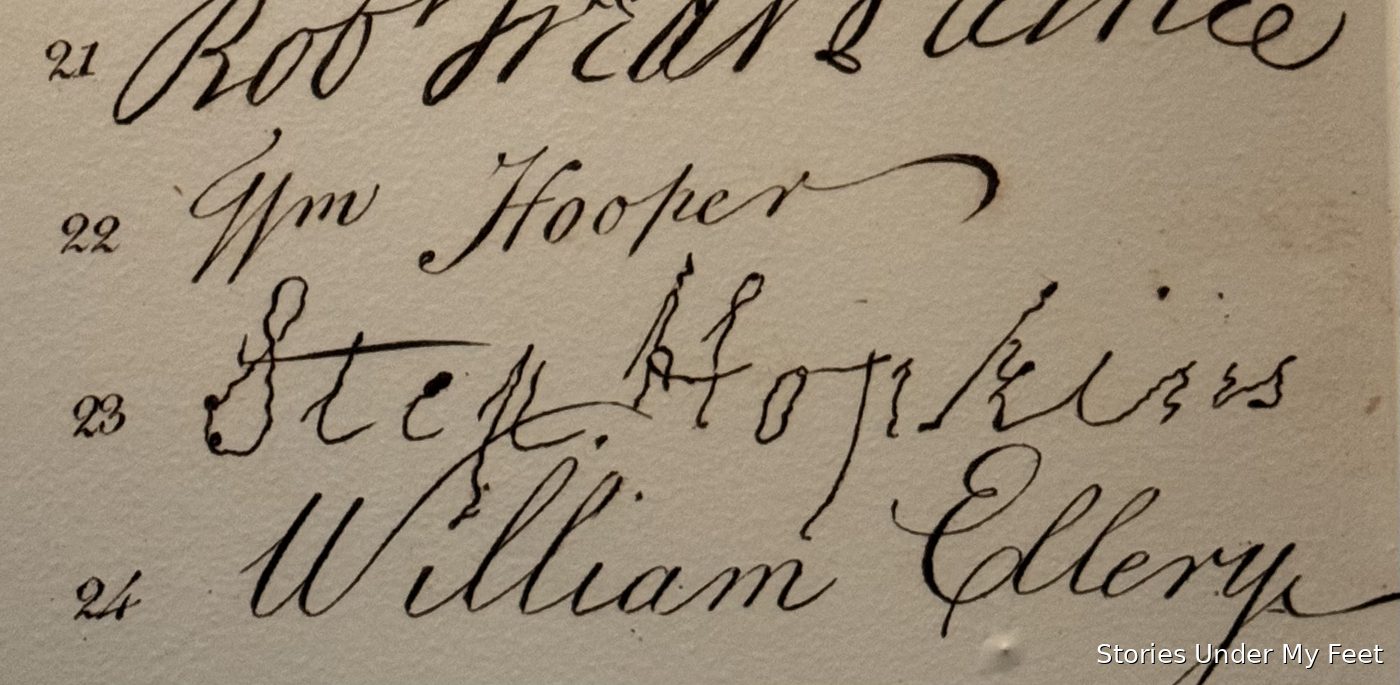
Part of that got answered at the American Philosophical Society Museum in Philadelphia — Philosophical Hall, right beside Independence Hall — in an exhibition called These Truths: The Declarations of Independence. Engraved copies of the Declaration were on display, each crowded with the signers' names, and one signature stopped me. Next to the others, this signature was — honestly — not beautiful at all: the line wobbled up and down like a little wave. A staff member told me the story. He was one of the oldest men to sign, and by then he could barely write; his hands shook too much to hold a steady line. That was Stephen Hopkins of Rhode Island, who had palsy. He braced his right hand with his left just to get his name down, and is remembered for saying, "My hand trembles, but my heart does not."
That wavy signature undid an assumption of mine as much as the ranger had. Not everyone in the past wrote like a printing press. Some of them could hardly hold the pen — and signed anyway.
Back to Jamestowne
So now, when I see Jamestowne with its extra e, I don't read it as a mistake anymore. I read it as a voice from before the rules — someone writing a place the way it sounded to them. See where all of this began: Jamestowne Is Founded, 1607.
Sources: Britannica, "Jamestown Colony"; Suzanne Kemmer, "The History of English: Spelling and Standardization" (Rice University); Wikipedia and the Descendants of the Signers of the Declaration of Independence on Stephen Hopkins.